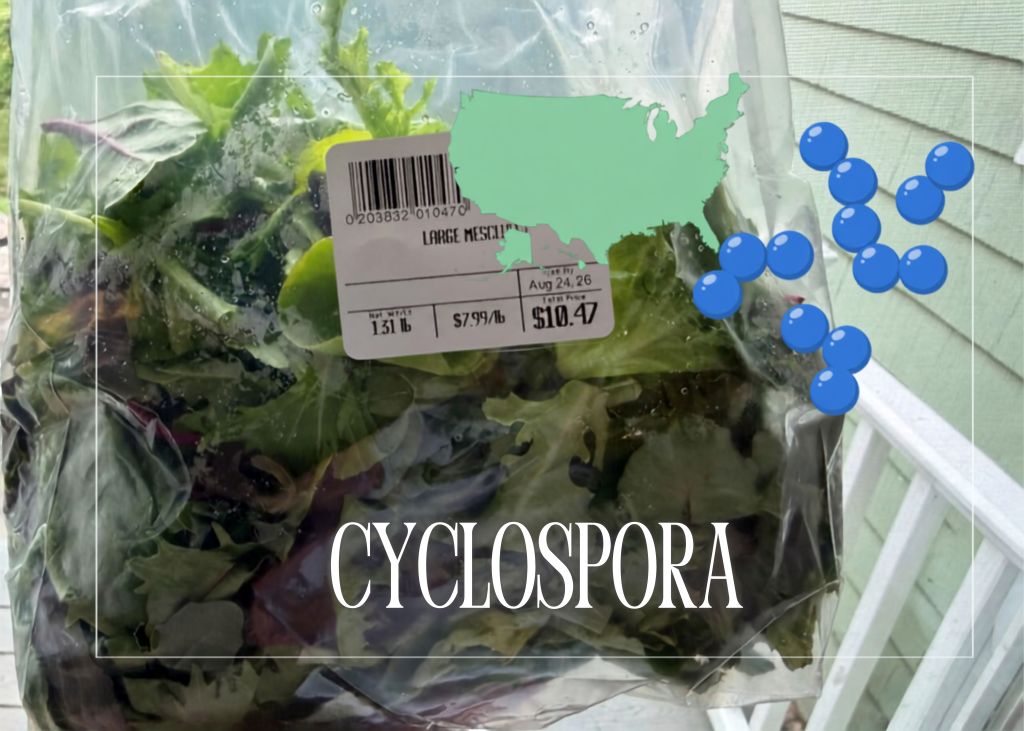
Have you ever heard people joke that Taco Bell gives you diarrhea? Well, in July, that joke got uncomfortably close to reality. A cyclospora outbreak linked to contaminated iceberg lettuce made its way into some Taco Bell locations, causing many customers across multiple states to get sick. That got me wondering, how could a microscopic parasite cause thousands of people across the USA to get ill, require hospitalization and in rare cases, cause death? So in today’s blog post, we will look at Amy Laskowski’s Q&A with Boston university infectious diseases expert David Hamer to understand how cyclospora spreads, why this outbreak has been so hard to track, and most importantly, what you can do to protect yourself.
After catching the attention of many this summer, cyclospora has become one of the most talked about foodborne parasites in the country. According to David Hamer, cases have now appeared in 39 states, which is so large that Hamer said that “This [cyclospora] has become a big outbreak.” That’s most of the US dealing with the same microscopic problem.
Cyclospora spreads when contaminated food or water with feces are consumed by people. We see this with Hamer explaining how infection happens when someone eats food containing “the cysts of the parasite.” These cysts are a group first identified in Nepal and Peru and belong to a protozoan parasite in the same family as cryptosporidium.
In the past, we have learned that cyclospora has been linked to fresh produce. Hamer notes that “the most common vehicle… has been imported raspberries, both black and red,” including a huge outbreak which was linked to Guatemala.
What’s fascinating to me was that contamination of the produce begins long before food reaches your plate. Hamer explains that when sanitation is lower in agricultural areas, “people are shedding the cysts and they end up contaminating the environment.” If workers have no proper place to, let’s just say go number two, contamination can occur directly in the fields. And if produce isn’t washed well afterward, “the stage is set for transmission of the parasite.”
Surprisingly, even washing isn’t always enough. The surface of foods like raspberries is “very irregular,” making it easy for cysts to hide. Past outbreaks have also involved produce such as cilantro, salad mixies, basil and snow peas.
One of the biggest challenges with cyclospora is diagnosis. Cyclospora doesn’t show up on a standard tool test. Hamer explains that clinicians must order “a special PCR assay” or a multiplex pathogen panel. If they don’t think to test for cyclospora, cases go undiagnosed.
This is why tracing the outbreak is extremely difficult. The CDC is currently analyzing food diaries to try to find common foods among sick individuals. Interestingly enough, Hamer admits, “I’m surprised they haven’t figured it out yet, honestly.” One reason may be that the suspected food, lettuce, is so widely consumed that both sick and healthy people eat it, making patterns harder to detect.
Even though the exact source hasn’t been found, Hamer offers some very applicable advice. Guess what it is? It is washing your hands and all produce thoroughly. He even says, “I don’t even trust prewashed–I wash.” Berries, with their tiny nooks and crannies, are especially tricky. Cyclospora is treatable, and symptoms can last for weeks if untreated. The primary medication is trimethoprim-sulfamethoxazole (Bactrim).


Leave a Reply